
Last modified: 2026-11-14 by rob raeside
Keywords: colombia | military |
Links: FOTW homepage |
search |
disclaimer and copyright |
write us |
mirrors
See also:

.gif) flag photo by Esteban Rivera, taken on 14 December 2024; coat of arms from
dbelen.com
The "Escuela de Asalto Aéreo" (ESASA) or Air Assault School
was established through Resolution 3986 of April 14, 2011 of
the Ministry of Defense to train Officers, Non-Commissioned Officers,
and Professional Soldiers of the Colombian Military Forces in the
planning, development, and execution of air assault operations with an
emphasis on jungle conditions, successfully combining strategic speed
with the tactical mobility of air elements.
Sources: [1],
[2], and
[3].
The flag is diagonally divided by a white stripe, having blue and the coat of arms on the left half and light brown on the right half.
Esteban Rivera, 19 April 2025
 flag photo and detail by Esteban Rivera, taken on 1 June 2025

 flag photo and detail by Esteban Rivera, taken on 1 June 2025

 flag photo and detail by Esteban Rivera, taken on 1 June 2025
 flag photo by Esteban Rivera, taken on 1 June 2025
 image by Eugene Ipavec, 25 August 2005
War Flag
 image by Eugene Ipavec, 14 June 2006
Standard - obverse
 image by Eugene Ipavec, 14 June 2006
Standard - reverse
 image by Eugene Ipavec, 14 June 2006
square "pennant"
 image by Eugene Ipavec, 14 June 2006
coat of arms
This military institution is called ESDEGUE (Escuela Superior
de Guerra, or Superior School of War). This is where the Colonels
study to become Generals and also where the Generals become Major
Generals and so on...
Official website: www.esdegue.mil.co.
E.R., 14 June 2006
The caption of the bottom of the ESDEGUE official flag reads
ESC. SUPERIOR DE GUERRA, and it follows the same pattern as other
official flags.
E.R., 25 August 2005
The Superior School of War was founded on 1 May 1909 by Decree No. 453 of
President of the Republic General Rafael Reyes Prieto to professionalize the
Colombian Armed Forces. Its first director was the Chilean Major Pedro Charpin
Rival; the first Colombian director, Alejandro Posada, was appointed in 1912.
The symbols of the Superior School of War are described on the institute's
website. The flag is in dimension 1.10 m x 1.35 m, blue with the coat of arms of
the institute in the middle. The flag is bordered with a 5-cm long golden
fringe, stating that the flag has been awarded the Cross of the Order of Boyacá
(see
http://www.armada.mil.co/index.php?idcategoria=1536 ).
The coat of arms of the Superior School is prescribed by Decree No. 2222 of the
Ministry of War, adopted on 14 December 1946. The shield is blue with a border
argent, in the upper part the writing "ESCUELA DE GUERRA / COLOMBIA", in the
lower part the writing "ESTUDIOS SUPERIORES", all in white. In the middle is
placed a red book outlined in golden yellow, supporting a lamp. A wreath of
laurel is placed under the book, a sword is placed horizontally above the lamp.
Argent represents integrity, firmness, honesty, tenacity and constancy. Blue
represents loyalty, serenity, majesty and royalty. The book symbolizes study,
while its golden border represents nobleness, light, knowledge and constancy.
Red represents strength. The lamp represents science and knowledge. The sword
represents power, justice, watch, authority and the nobleness of all the
military virtues. The laurel is the symbol of fame; the laurel wreath awards the
heroic acts, force and personal merit.
www.esdegue.mil.co
Note that the coat of arms shown here has a different writing, "ESCUELA SUPERIOR
DE GUERRA" on top and "COLOMBIA" on bottom.
Ivan Sache, 15 November 2010
War Flag

 images by Eugene Ipavec, 7 February 2006 and Esteban Rivera, 9
July 2026
Source:
https://x.com/ejercito_cedoc/status (this flag features the initials ESLAN
instead of the School's name.
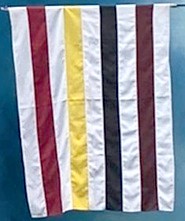
Standard


 images by Eugene Ipavec, 10 September 2006 and Esteban Rivera, 9
July 2026
Sources of photos: https://x.com/ejercito_cedoc/status
(the first photo features the arms between the purple (bottom) and red (stripes);
this means that the color stripes of the flag are from top to bottom red,
yellow, black and purple and not red, yellow, black and red) and
https://x.com/COL_EJERCITO/status.
Esteban Rivera, 9
July 2026
Standard - detail.gif) image by Eugene Ipavec, 10 September 2006
Logo
eslan.gif) image by Eugene Ipavec, 10 September 2006
B Company Pennant
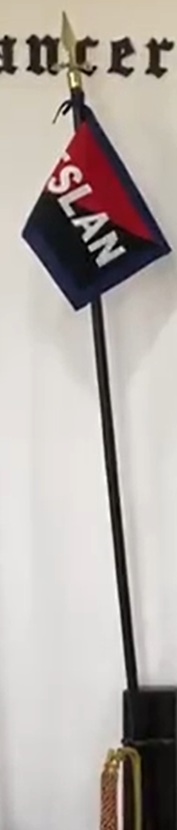 image located by Esteban Rivera, 9
July 2026
Source:
https://www.instagram.com/p/DShvngjjvyc
This is the flag of the Escuela de Lanceros (or Lancers
School), in which the military and police personnel of the
Colombian forces take courses to become an elite force of highly
trained mobile force to combat the guerilla and the
paramilitaries. It is based on the US Army Ranger system, and
lots of foreign applicants go there as well. The flag is the
Colombian flag, plus the Coat of Arms and on the bottom it reads
ESCUELA DE LANCEROS.
These units as elite units, initially within the Cavalry Branch
of the Colombian Army, but currently it is another specialty
course taken by any Army member who passes the tests and is
eligible to take the course.
I recall that when this Lancers School was established back in
the mid 1950's during the military regime of General Gustavo
Rojas Pinilla (who took power on a coup d'etat and actually ran a
series of military reforms), the model of the Lancers School was
taken form the U.S. Rangers.
For further information about the Escuela de Lanceros, please refer to www.specwarnet.com
Source: Picture taken at the Indepenedence Day parade held in Bogota on
July 20, 2004 ( from the Ministry of National Defense at www.mindefensa.gov.co).
E.R., 7 February 2006
The additional official flag is based on photo of the flag
taken by me at the Museo Militar. Coat of Arms based on
García, Julio Cesar: "Himnos y Símbolos de Nuestra
Colombia", Camer Editores (2000).
The motto reads on black letters LEALTADA, VALOR, SACRIFICIO
(Loyalty, Valor, Sacrifice).
ESLAN official website is at www.eslan.mil.co.
E.R., 10 September 2006
The proportions of the stripes are 4:2:3:2:5:2:3:2:4. The logo
inside the shield on the flag is simplified and thus
significantly different from the normal ESLAN logo.
Eugene Ipavec, 10 September 2006
There was a military parade in the city of Villavicencio, the capital of the
Department of Meta. During the parede, a
picture shows a Pennant with the colors of the Lancers School Standard
and the black letter "A", most likely standing for A Company of the School.
Source:
http://www.ejercito.mil.co/?idcategoria=251100
Esteban Rivera, 9 July 2010
The Lancer's School was established on December 6, 1955, with help from US
Army Rangers establishing a "Lancero" (Lancer) training program as part of a
Military Professional Exchange Programs, Military PEP), to train small-unit
leaders (Officers and NCOs) for irregular and counterinsurgency (COIN) warfare
to develop to the maximum, by practical field training, the potential for
military command and leadership of selected company-grade officers and
noncommissioned officers throughout the Army in order to improve the leadership
and training capabilities of all units. The name derives from the elite
cavalrymen in the Army during the South American wars of independence from Spain
during the XIXth century. The initial training course lasted 11 weeks and
currently the Lancero course is seventy-three days long or 42 consecutive days,
where students must get at least a 70 percent rating in each phase to graduate
as Lanceros, with the final field test being a Survival, Evasion, Resistance,
and Escape (SERE) exercise conducted in the Department of Amazonas.
International personnel also attend the course.
The Lancers School is the
pioneer of all other Combat Schools.
It is currently located at the
"Fuerte Militar de Tolemaida" (Tolemaida's Military Fort) in
Nilo, Cundinamarca.
For additional information go to Escuela de Lanceros (additional official
website):
https://www.ejercito.mil.co/escuela-de-lanceros
Esteban Rivera, 9
July 2026
 image by Eugene Ipavec, 20 December 2005
War Flag
 image by Eugene Ipavec, 3 October 2005
Standard - obverse
 image by Eugene Ipavec, 3 October 2005
Standard - reverse
 image by Eugene Ipavec, 26 December 2005
pennant
Flag of the Escuela Militar de Cadetes "General José
María Córdova" (Military Cadet School Jose Maria Cordova).
It is often abbreviated as ESMIC (EScuela MIlitar de Cadetes).
This school is for all Army Cadet students who want to be
officers.
Description of the flag: Horizontally divided flag, with upper
side divided into two equal stripes (bootom left green, top
right, red). On the obverse the Coat of Arms is located on the
green part of the flag.
Sources: Coat of Arms at "Himnos y Símbolos de Nuestra
Colombia", by Julio César García, Camer Editing 2000. ISBN
958-33-1489-7 page 175, photos from official site www.esmic.edu.co.
E.R., 3 October 2005
There is another official flag of this Military Cadet School.
All military flags have the same legislation (the flag of
Colombia plus the lettering of the Unit, and also another
official flag with its on Coat of Arms and the proper color
background).
Source: photo taken at Colombia's Independence Day in
Madrid, 2005.
There is also pennant of this Military Cadet School. Notice that
it reads JMC, the initials of the name of the School (José
María Córdova).
Source: photo taken at Colombia's Independence Day
Parade in Bogotá, July 20, 2003.
E.R., 20 and 26 December 2005
The official name is Escuela Militar de Cadetes José María
Córdova (and not Córdoba). The difference is the "v"
goes instead of "b". The explanation for this is pretty
simple: back in the 1800's the last name of the youngest Army
General in the Colombian Army (José María Córdova), the
spelling was with "v". However the Department of
Córdoba is spelled with "b". So, for all military
purposes, the name of this General is spelled with "v"
(The top Army Order is called José María Córdova) and for all
civilian purposes it's spelled Córdoba (for example the Police
Command for the Department is called Córdoba).
This Military Cadet School is a University level institution.
This transition towards full academic approval by the Colombian
Education authorities was done very recently.
E.R., 28 December 2005
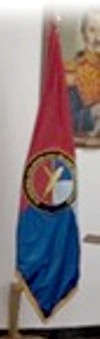 image located by Esteban
Rivera, 11 August 2026
The "Academia Colombiana de Historia Militar" (Colombian Academy of Military
History) was established on June 30, 1992 and it is a non-profit private
cultural organization of military interest. It is located inside the premises of
the ESMIC, in the "Biblioteca Central de las Fuerzas Militares 'Tomas Rueda
Vargas'" (: Central Library of the Military Forces 'Tomas Rueda Vargas')
Source:
https://esdegue.edu.co/es/biblioteca-central-ffmm
Its flag is a
horizontal (measures) featuring the three plain color backgrounds of
each Force with red
(representing the Army) having 1/2 of the flag space and the rest covered by
navy blue (representing the Navy) and sky blue (representing the Air Force)
covering both the other 1/2, vertically divided.
Esteban
Rivera, 11 August 2026
Logo
.gif) image located by Esteban
Rivera, 11 August 2026
Source:
https://esdegue.edu.co/es/biblioteca-central-ffmm
 image by Eugene Ipavec, 3 November 2005
obverse
 image by Eugene Ipavec, 8 March 2006
reverse
emsub.gif) image contributed by E.R., 3 November 2005
coat of arms
 image by Eugene Ipavec
director pennant
 image from esufa.edu.co
war flag
Notice that the war flag features on top "ESCUELA MILITAR DE SUBOFICIALES" [MILITARY SCHOOL OF NON COMMISSIONED OFFICERS] and below the initials "S.S." meaning "Sargento Segundo"
[Second Sargeant] and "INOCENCIO CHINCÁ" (the latter, the name of the soldier honoured).
Esteban Rivera, 15 November 2024
Coat of Arms and flag of the Escuela Militar de Suboficiales
Sargento Inocencio Chincá (NCO's Military School Sargeant
Inocencio Chinca). The official abbreviation is EMSUB. Official website at http://www.emsub.mil.co.
E.R., 3 November 2005
The Pennant of the Director of the EMSUB is seen at www.ejercito.mil.co
on a photograph taken on July 20, during a military parade held
in Bogotá to commemorate Colombia's Independence Day.
It is a tricolour Pennant, with the rank of Colonel in yellow.
This follows the same pattern as the General
commanding a Unit Rank Flag.
The EMSUB is headed by a Colonel. However military schools head's
are called Directors and not Commanders.
E.R., 10 August 2009
 image by Eugene Ipavec, 25 August 2008
.gif) image by Eugene Ipavec, 25 August 2008
Coat of Arms
Centro de Educación Militar (CEMIL, Military Education Center) is
located in Bogotá. The CEMIL flag is a red and charged with the coat of arms.
The coat of arms can be seen in the school's website at www.cemil.mil.co.
The CEMIL was previously named Decimoquinta Brigada (Fifteenth
Brigade), and its symbols were the Roman Numerals XV.
CEMIL is in charge of study, doctrine and leadership and
handles the curriculum of the following schools:
- Escuela de Armas y Servicios
- Escuela de Infantería
- Escuela de Caballería
- Escuela de Artillería
- Escuela de Ingenieros Militares
- Escuela de Comunicaciones
- Escuela de Logística
- Escuela de Policía Militar
- Escuela de Relaciones Civiles y Militares
- Escuela de Equitación
- Escuela de Aviación Ejército
- Batallón de Servicios para la Educación Militar
- Compañia Avanzada de Tiro.
Source: www.cemil.mil.co.
E.R., 25 August 2008
Previous Flag of Decimoquinta Brigada (Fifteenth Brigade)
 image by Eugene Ipavec, 25 August 2008
The "Brigada de Institutos Militares, BIM" (Military Institutions Brigade)
lasted from 1938 until 1995. In 1995 it is transformed into the "Decimoquinta
Brigada" (Fifteenth Brigade) encompassing the following Schools:
-
Escuela Militar de Suboficiales del Ejército Nacional, EMSUB
-
Escuela de las Armas y Servicios (Arms and Service Branches Schools)
which are (the first four were the main core ones and whenever new Specialties
and Service Branches were added, new Schools were added as well):
- Escuela de Infantería, ESINF (Infantry School)
- Escuela de Caballería, ESCAB (Cavalry School)
- Escuela de Artillería, ESART (Artillery School)
- Escuela de Ingenieros Militares, ESING (Military Engineers School)
- Escuela de Logística, ESLOG (Logistics School)
- Escuela de Comunicaciones Militares, ESCOM (Military Communications School)
- Escuela de Policía Militar, ESPOM (Military Police School)
- Escuela de Lanceros, ESLAN (Lancers School).
- Escuela de Relaciones Cívico Militares, ERCM (Civic Military Affairs School)
- Escuela de Aviación Ejército, ESAVE (Army Aviation School)
-
Escuela de Paracaidismo Militar, ESPAM (Military
Parachuting School)
- Escuela de
Selva, ESSEL (Jungle School)
- Escuelas de
Capacitación de las Armas, ESARM (Service Branches Training Schools)
- Escuela de Tiro, ESTIR (Shooting School)
From 2000
onwards it was renamed "Centro Nacional de Entrenamiento, CENAE" (National
Training Center) and "Centro de
Educación Militar, CEMIL" (English: Military Education Center) (https://cemil.edu.co) .
Sources:
https://www.cemil.edu.co/index.php/informacion-de-interes/resena-historica,
https://www.cemil.edu.co/resena and
https://es.wikipedia.org/wiki/Brigada_de_Institutos_Militares
Esteban Rivera, 11 August 2026
 image by Eugene Ipavec, 31
October 2006
obverse
 image by Eugene Ipavec,
31 October 2006
reverse
Escuela de Infantería (Infantry School) is known fir short as
ESINF. Three days after the declaration of Independence, on July
23, 1810, the Batallón de Voluntarios de la Guardia Nacional
(Volunteer Battallion of the National Guard) was established.
This was the genesis of today's Colombian Infantry units. Later
on by Decree 578 of May 18, 1907, the President General Rafael
Reyes creates the Batallón Modelo de Ifantería (Model Infantry
Batallion) in order to adopt the reforms of the Chilean mission.
Sources: Julio César García: Himnos y Símbolos de Nuestra
Colombia, Camer Editing, (2000), page 179. Official websute at www.jedoc.mil.co
Photo of the reverse of flag. Image on Independence Day parade of
2005. Photo taken at Colombian Independence Day Parade on July
20, 2006
Official website at www.esinf.mil.co.
E.R., 31 October 2006
The Colombian Army's Infantry School's motto featured on its
Coat of Arms is PASO DE VENCEDORES (Victors march). This writing
appears on the lower part of the Coat of Arms.
Source: Official
website.
E.R., 24 August 2008
 image from Facebook
It seems that Flight Instructors of the "Escuela Internacional de Ala
Fija, ESIAF" (International Fixed Wing School) display a
pennant featuring the aircraft's patch on during operations and
training missions and it is a white horizontal background with a blue
stripe around the edges with the patch in the middle.
Colombia acquired a total of 10 Beechcraft T-6 Texan II, a
single-engine turboprop aircraft built by Textron Aviation (official
website: txtav.com). It is a license-built Pilatus PC-9,
a trainer aircraft. The first batch of six units arrived in the
country on July 11, 2021.
Sources: [1],
[2],
and [3].
Esteban Rivera, 19 April 2025
 image by E.R., 10 August 2009
The Director's Pennant of the ESPAM (Escuela de Paracaidismo
Militar) is seen here
in this picture reported on the official Army website taken in
Bogota on July 20 during Colombia's Independence Day.
Notice that this is the School's Standard, and as some other
schools, the ESPAM flag may also have its Coat of Arms in the
middle. The Coat of Arms is seen on their official
website which is a combination of several Course Badges as
seen here
and here.
One more Pennant regarding this subject is seen at this picture:
a triangular black pennant with a yellow outline with the yellow
capital letters SLIIDI(V?). My best guess is that this may be it
is a current military parachute course.
E.R., 10 August 2009
The "II" are really // (slashes) I believe.
Jan Mertens, 11 August 2009


